
Article 102 Explained: When Can the High Court Division Review Government Action?
Article 102 allows the High Court Division to enforce fundamental rights and supervise the legality of public power. It is available where…
5 min readRead
Authoritative guidance on the Constitution of Bangladesh, fundamental rights, judicial review, citizenship, elections and the lawful exercise of public power.
This subject explains how constitutional guarantees, public institutions and administrative decisions affect individuals, organisations and the state.
Equality, liberty, due process and enforceable constitutional protections.
View guidanceConstitutional remedies before the High Court Division.
View guidanceReview of laws, executive action and decisions of public bodies.
View guidanceNationality, dual citizenship, eligibility and public responsibilities.
View guidanceElectoral institutions, representation and constitutional accountability.
View guidanceFair procedure, lawful discretion and remedies against public authorities.
View guidanceShowing material matching “judicial review”.
Clear searchArticle 102 allows the High Court Division to enforce fundamental rights and supervise the legality of public power. It is available where…
A Bangladeshi passport authority may refuse to issue, impound or revoke a passport only under the Bangladesh Passport Order, 1973 and other…
An administrative decision may be challenged where the authority was legally required to act fairly but failed to give the affected person…
Article 39 protects freedom of thought and conscience and guarantees citizens’ freedom of speech, expression and the press. Speech may be restricted…
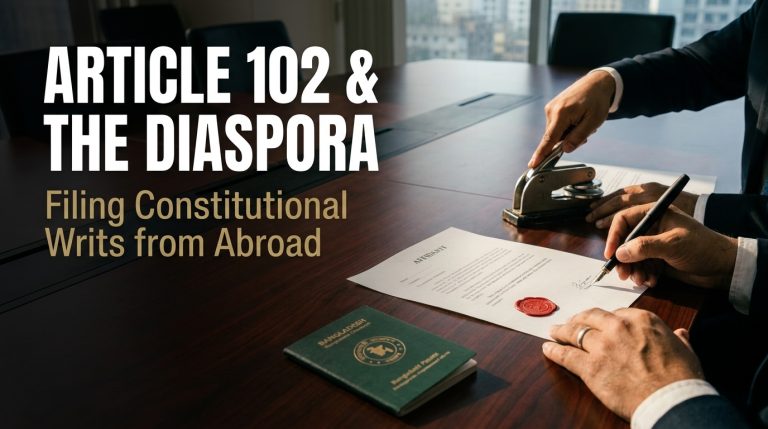
A Bangladeshi living abroad may file an application under Article 102 of the Constitution if the person has the necessary standing and…
Living outside Bangladesh does not, by itself, remove a person’s constitutional rights as a Bangladeshi citizen. Some constitutional rights expressly belong to…
Ain.bd separates the governing rule from interpretation and identifies the institution, procedure and documents relevant to the next step.
Editorial BoardIdentify the legal relationship, document, decision, allegation or procedure.
Use the Constitution, statute, rule, judgment or official administrative source.
Clarify jurisdiction, time limits, documents and the responsible institution.